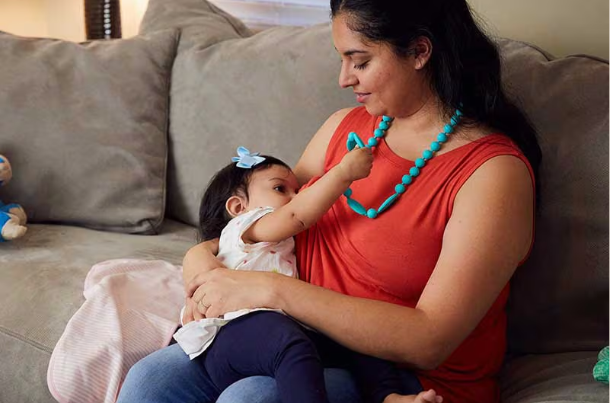
You hold a little rattle in front of your baby, and their eyes follow it carefully. A hand lifts, an arm swings, and suddenly you’re wondering, when do babies reach for toys? Early attempts often emerge around 3 to 4 months, while reaching deliberately to grab a wanted toy is a milestone most babies achieve by 6 months.
There can be so much curiosity behind that small movement. Your baby notices something interesting and begins figuring out how to bring it closer.
But the first attempts aren’t always obvious. Let’s look at the timeline, simple ways to encourage play, and when to ask your pediatrician for guidance.
When Do Babies Reach for Toys? Understanding the Timeline
Reaching develops gradually. Watching a toy, swinging toward it, holding it when offered, and deliberately grabbing it are related, but different, abilities.
When asking when babies reach for toys, distinguish an early arm movement from a coordinated reach-and-grab sequence.
The CDC lists holding a toy placed in the hand and swinging an arm at toys as 4-month milestones. Reaching to grab a desired toy appears on its 6-month checklist.
These are checkpoints for discussing progress, rather than predictions of the exact day a skill will appear. CDC milestones describe skills most children—75% or more—can do by a particular age. The checklists support conversations but do not replace standardized developmental screening.
In the Early Months: Looking and Moving
Before reaching becomes clear, you may notice your baby watching a toy, moving their arms nearby, or briefly touching something you hold.
It can be difficult to tell whether contact was intentional. You don’t need to decide every time.
Notice what happens across ordinary play: does your baby become interested, watch the object, or make movements toward it? These observations are useful even before you see a successful grab.
Around 3 to 4 Months: Early Attempts
During this period, you may begin seeing arm movements directed toward an interesting object.
At first, the hand might miss, brush the toy, or knock it away. By 4 months, most babies can swing an arm at toys and hold one placed in their hand, according to the CDC.
Holding a rattle you offer is worth noticing, but it isn’t quite the same as reaching out and collecting it independently.
By 6 Months: Reaching to Grab
By 6 months, most babies reach to grab a toy they want.
Your baby might look at a rattle, extend an arm, and close their hand around it. The action may still look a little unsteady.
A successful reach doesn’t mean every attempt will work. Position, interest, tiredness, and the toy itself can affect what you see during a particular play session.
What Does Early Reaching Look Like?
The first signs can be easy to overlook.
Your baby may watch a toy and bring an arm toward it, open their hand nearby, or repeatedly touch something hanging within reach.
Over time, the movement may look more purposeful: looking, reaching, touching, and holding become easier to recognize as one sequence.
Avoid moving the toy away every time your baby gets close. Give them opportunities to make contact and enjoy the result.
If you’re uncertain what you’re seeing, describe it simply: “She watches the rattle and swings toward it, but doesn’t hold it yet.” That is useful information for your pediatrician.
Reaching and Grasping Are Different Skills
Reaching means moving toward an object. Grasping means holding it.
A baby may manage one part before the whole sequence becomes coordinated. They might touch a toy without securing it or hold something you place in their hand without reaching for it themselves.
Think about the task you’re offering, too. A large, heavy object may be difficult to hold even when your baby is interested and reaching.
Try a lightweight, age-appropriate toy with an easy-to-hold shape. You’re making the opportunity manageable, rather than testing how hard your baby can work.
A Quick Guide to What You Are Seeing
It can help to describe the action rather than label your baby as ahead or behind. These observations give you useful details to share at a developmental check.
| What your baby does | What it tells you |
|---|---|
| Looks toward a toy | They are attending to it; this does not establish reaching ability. |
| Swings an arm and touches a toy | This may be an early attempt, even without a secure hold. |
| Holds a toy placed in the hand | Holding is emerging, but the baby has not necessarily reached for it. |
| Looks, extends an arm, and grabs | Several parts of the reach-and-grasp sequence are working together. |
The sequence is a guide to observations, not a test you need to complete at home. Notice abilities across comfortable, awake play rather than expecting every skill in one session. Share persistent concerns even if your baby sometimes manages part of the movement.
Gentle Ways to Encourage Reaching
You don’t need a special developmental program. A safe space, a suitable toy, and your attention offer plenty of possibilities.
1. Choose a Comfortable, Awake Moment
Start when your baby seems settled and interested in looking around.
A hungry or tired baby may have little interest in toys. If they turn away, fuss, or seem ready to stop, take a break.
Keep these moments short and enjoyable. You don’t need to finish a certain number of attempts.
2. Offer One Toy at a Time
Hold a suitable toy where your baby can see it and realistically reach it.
Pause long enough for them to look and respond. Avoid rapidly shaking it or switching between several objects.
One clear opportunity can make it easier to notice what interests your baby. If they aren’t interested, you can put it away and try another time.
3. Use Supervised Floor Play
A firm, comfortable floor space gives your baby room to move their arms and body while you stay close.
Offer safe opportunities to explore and reach during supervised floor play. Use a clear area away from pets, small objects, and the feet of older children.
Place the toy within a manageable distance. As your baby’s abilities develop, you can adjust the position without making it frustratingly inaccessible.
4. Include Tummy Time While Awake
Supervised tummy time gives your baby another position for exploring.
Place an interesting toy where they can see it, and stay beside them. Their ability to reach from this position may look different from what they manage on their back.
Tummy time helps develop the neck and trunk control used in many movements, but it does not mean your baby must reach from that position immediately.
Keep tummy time for awake, supervised play. Put your baby on their back for sleep.
5. Offer Opportunities on Both Sides
During different play moments, offer toys near the middle and slightly to either side.
Watch how your baby moves naturally. Don’t hold one arm down or force the other to participate.
If your baby consistently avoids using one arm or one side of their body, discuss that with their pediatrician rather than trying to correct it yourself.
6. Let Them Explore After the Grab
Once your baby holds the toy, allow time to look, feel, and move it.
You might say, “You got your rattle!” Then let them explore without immediately asking for another reach.
Your warm response can keep the moment enjoyable. There is no need to turn every success into the next challenge.
Choosing Toys for Early Reaching
Start with lightweight toys designed for your baby’s age and stage.
You might try a simple rattle, an infant-safe grasping toy, or a cloth book. Choose an easy-to-hold shape without loose parts, long cords, or damage. Let your baby explore at their own pace.
Check the actual object rather than relying on how appealing it looks. Is it easy to hold? Is it intact? Could a piece detach?
Avoid small parts, accessible button batteries, powerful magnets, and other choking hazards. Follow the toy’s age and safety instructions, inspect it regularly, and keep older children’s small toys out of reach.
Keep toys out of your baby’s sleep space. Reaching practice belongs in supervised play, not in a cot filled with objects overnight.
What If Your Baby Watches but Doesn’t Reach?
Watching shows interest, but it doesn’t tell you everything about movement.
Consider the setup. Is the toy too far away, too heavy, or difficult to see? Is your baby comfortable and awake? Have you given them time to respond?
Make one simple adjustment and observe. Avoid repeatedly testing throughout the day.
If your baby is missing an age-expected skill or something concerns you, ask their pediatrician. A different toy may improve the opportunity, but it shouldn’t be used to postpone a developmental discussion.
What If Your Baby Was Born Early?
For babies born prematurely, clinicians often use corrected age when assessing early development.
Corrected age accounts for how many weeks before the due date your baby was born. For example, a baby born eight weeks early who is now four months old has a corrected age of about two months.
Ask your pediatrician which age to use and how to interpret your baby’s progress. Corrected age is commonly used to interpret early milestones during the first two years, alongside your child’s individual medical and developmental history.
Corrected age provides important context. You can still raise concerns about movement, comfort, or lost abilities whenever they arise.
When Should You Speak With Your Pediatrician?
Bring up concerns if your baby isn’t swinging toward toys or holding an offered toy around the 4-month checkpoint, or isn’t reaching to grab a wanted toy by 6 months. Ask how corrected age applies if needed.
Discuss missed milestones, lost skills, or other developmental concerns and ask about screening. You do not need to wait until the next routine visit if a concern appears now.
Also seek advice if your baby:
- Consistently uses one arm or side much less.
- Seems unusually stiff or floppy.
- Appears to have difficulty seeing or following objects.
- Seems to experience pain with movement.
- Stops doing something they previously could do.
A missed milestone doesn’t establish a diagnosis. It gives you a reason to look more closely with someone qualified to assess your baby.
Loss of a previously used skill deserves prompt medical advice. Sudden weakness, a new inability to move an arm, significant pain after an injury, or an acutely unwell baby needs urgent assessment rather than milestone practice.
A short video of natural play may help illustrate what you’ve noticed. You don’t need to stage repeated attempts for the camera.
Frequently Asked Questions
Is batting at toys the same as reaching?
Batting can be an early movement toward a toy, but it differs from deliberately reaching and holding it. Describe what your baby does rather than worrying about the perfect label.
When should my baby grab a toy independently?
The CDC lists reaching to grab a wanted toy as a 6-month milestone. Earlier holding may happen when you place the toy in their hand.
Should I put a toy directly into my baby’s hand?
You can gently offer an appropriate toy and let your baby hold it if they’re comfortable. Don’t force their fingers around it. Also provide opportunities to move toward a nearby toy themselves.
Does my baby need expensive toys to learn reaching?
No. A few suitable, easy-to-hold toys can offer useful play opportunities. Focus on safety, manageable size and weight, and your baby’s interest rather than product claims.
What if my baby reaches with only one hand?
An occasional reach with one hand doesn’t tell the whole story. However, consistent avoidance or reduced use of one side should be discussed with a pediatrician.
How long should we practice each day?
There is no required number of reaching attempts. Offer short opportunities during comfortable, supervised play and stop when your baby needs a break. Ask for individualized advice if there are developmental concerns.
Is reaching the same as pointing?
No. Reaching is movement toward an object, often to obtain it. Pointing is a gesture used to direct someone’s attention. They have different developmental timelines.
Does Reaching Early Mean My Baby Is More Advanced?
One early skill does not establish overall development or predict future ability. Babies develop several skills at different rates. Enjoy the moment without increasing the difficulty to prove progress, and continue discussing development as a whole at routine visits.
Can I Use a Phone Video to Encourage Reaching?
A screen is not needed for reaching practice. A suitable physical toy gives your baby something they can see, touch, and hold. Keep phones and other heavy objects away from their grasp, and focus on shared, supervised play rather than trying to make them reach toward a video.
What if My Baby Always Keeps Their Hands Closed?
Occasional closed hands are different from a persistent pattern. If your baby rarely opens their hands, seems stiff, uses one side much less, or cannot comfortably hold an offered toy around the expected age, discuss what you see with their pediatrician. Do not force their fingers open or begin exercises without guidance.
A Warm Reminder for the Parent Watching Closely
A little question about a toy can quickly become a much bigger worry about whether your baby is doing enough.
Keep offering gentle opportunities to explore. Notice the small changes, enjoy the attempts, and let play remain something you share rather than a daily examination.
If you’re concerned, ask. You can appreciate your baby’s progress and seek guidance at the same time. Your little one deserves patient support, and you deserve clear answers as you watch those first curious movements become more purposeful.
For your next play moment, offer one safe toy within comfortable reach and give your baby time. If a milestone is missing or movement worries you, bring those observations to your pediatrician while continuing gentle play.
Resources
American Academy of Pediatrics: How to Buy Safe Toys
American Academy of Pediatrics: Corrected Age for Preemies
American Academy of Pediatrics: Your Preemie’s Growth and Developmental Milestones