If you’ve ever listened to your child happily count toys and suddenly wondered, “How high should a 5 year old count?” you’re definitely not the only parent asking. At this age, one child may confidently count past 100, while another is still building confidence with smaller numbers. Those differences can feel much bigger to parents than they do to children.
The important thing to remember is that learning numbers isn’t a race. Counting is only one part of early math development, and understanding what numbers actually mean matters just as much as being able to recite them in order.
So instead of worrying about whether your little one is “ahead” or “behind,” let’s look at the number skills many 5-year-olds are developing and some playful ways you can practice them together at home.
How High Should a 5 Year Old Count?
There isn’t one magic number every child must reach on their fifth birthday. Children develop at different rates, and their counting ability can depend on their previous exposure to numbers, preschool experience, interests, and opportunities to practice.
For a concrete reference, the CDC’s age-five milestones include counting to 10 and naming some written numbers between 1 and 5 when someone points to them. These are developmental markers, not a maximum your child should stop at or a test that diagnoses a delay.
School expectations are a separate matter. Some kindergarten curricula work toward counting to 100 during the school year, but that does not mean every child needs to arrive already able to do it. Understanding smaller quantities deserves attention alongside learning longer number sequences.
Another meaningful skill is being able to count actual objects accurately. Start with three to five toy cars. Can your child touch or move each one while saying one number for each car? Increase the group gradually when that becomes comfortable; 12 cars can be a later challenge rather than an entry requirement.
That shows they’re beginning to understand that numbers represent real quantities, not just words in a catchy sequence.
How Far Should a 5 Year Old Count Without Help?
If you’re wondering how far should a 5 year old count independently, you may see a surprisingly wide range.
Some 5-year-olds can count well beyond 100 because they enjoy number sequences and have practiced them often. Others may count to 10, 20, or 30 before needing help. These examples are not a measured “normal range”; consider your child’s opportunities to learn, their understanding, and any concerns from their teacher.
Instead of focusing only on the highest number your child can reach, pay attention to how they count. Can they keep the correct sequence? Can they count objects one at a time? Do they understand that the final number tells them how many objects there are?
Those little details tell you much more about their developing number sense. A child who needs a prompt at one number may still understand a small group very well. Try observing during play instead of asking them to perform a long sequence on demand.
Should a 5 Year Old Count to 100?
You may have heard that children should be able to count to 100 in kindergarten, which naturally leads parents to wonder, should a 5 year old count to 100 already?
Not necessarily.
For example, the U.S. Common Core kindergarten standards include counting to 100 by ones and tens. This is a kindergarten learning goal, not a universal fifth-birthday milestone. Curricula and school starting ages vary across countries and school systems, so ask your child’s teacher what they are currently working toward. A child who cannot yet independently recite every number to 100 at age 5 isn’t automatically struggling with math.
Think about it this way: memorizing the words from 1 to 100 is a little like memorizing a song. It demonstrates memory and familiarity with number order, but it doesn’t necessarily mean the child understands quantities, patterns, comparisons, or simple calculations.
Those deeper skills deserve plenty of attention too.
What Numbers Should a 5 Year Old Know?
When parents ask what numbers a 5-year-old should know, it helps to look beyond how many number names the child has memorized.
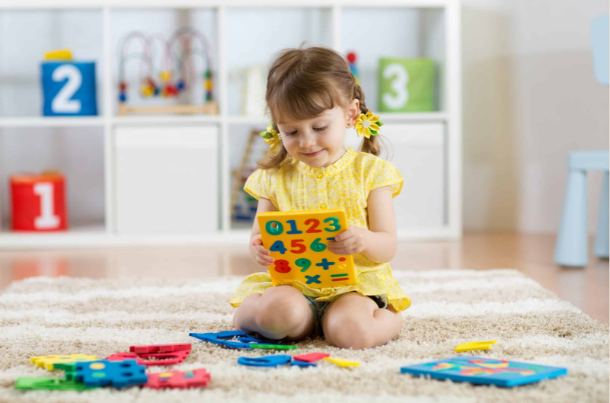
At this age, children are building several skills at once. They may be learning to recognize written numerals, connect those numerals with quantities, compare groups, and understand simple ideas such as “more,” “less,” “before,” and “after.”
For example, as these skills develop, your child may see the numeral 7 and connect it with seven objects. This is an example of learning in progress, not something every child must demonstrate immediately after turning five. They might also understand that 8 comes after 7 or that a bowl containing eight strawberries has more than a bowl containing four.
That kind of understanding creates the foundation they’ll use later for addition, subtraction, and other math concepts.
Important Counting Skills for 5 Year Olds
The counting skills for 5 year olds that matter most aren’t limited to reciting increasingly large numbers.
Your child is gradually learning that every object should be counted once, numbers always follow a particular order, and the last number said represents the total number of objects.
You might also notice them beginning to recognize number patterns. They may understand what comes next in a sequence or start counting forward from a number other than one.
These skills can develop unevenly. Your child might recognize written numbers beautifully but still lose track when counting a messy pile of blocks. Another child may count objects accurately but occasionally write numbers backward.
Both children are still learning.
To check the idea of “how many,” count a small group together and then ask, “How many are there altogether?” If your child starts counting again, model the answer: “One, two, three, four, there are four blocks.” Repeat this naturally over time rather than turning it into a pass-or-fail task.
Kindergarten Counting Skills Parents Can Encourage
Once children enter kindergarten, math becomes more structured, but that doesn’t mean learning needs to become serious or stressful at home.
Common kindergarten counting skills include counting objects accurately, recognizing and writing numerals, comparing quantities, understanding number order, and beginning simple addition and subtraction concepts.
Children may also start practicing counting forward from different numbers rather than always beginning with one.
So instead of asking, “Can you count to 100?” every day, try asking something like, “What comes after 16?” or “Can you give me eight crackers?”
Those questions encourage your child to use numbers rather than simply recite them.
Math Milestones for 5 Year Olds: What Really Matters?
I know milestones can sometimes make parenting feel like we’re constantly checking invisible boxes.
Can they write their name?
Can they read yet?
Can they count to 100?
But math milestones for 5 year olds are better viewed as a general guide rather than a deadline stamped onto your child’s fifth birthday.
At this age, you may notice your child becoming more comfortable with:
- Counting objects one by one
- Recognizing familiar written numbers
- Comparing which group has more or fewer objects
- Understanding basic number order
- Matching numbers with quantities
- Noticing simple patterns
- Beginning to understand simple addition and subtraction through real objects
Your child doesn’t need to master every skill at exactly the same moment as another child.
Progress is what you’re looking for.
Counting to 100 Isn’t the Same as Understanding 100
This distinction can help parents choose useful practice activities.
Imagine your child proudly counts from 1 to 100 without making a single mistake. Wonderful!
Now place 14 large blocks on the table and ask how many there are. If your child loses track while counting them, that’s simply a different skill they still need to practice.
On the other hand, a child who only counts aloud to 30 may accurately count 17 blocks, recognize the number 17, and understand that 18 is one more.
So when thinking about how high a 5-year-old should count, don’t let the biggest number become the only measure of your child’s math ability.
Understanding numbers matters more than putting on a counting performance.
Fun Number Activities for 5 Year Olds
The nicest thing about early math is that you don’t need worksheets, expensive learning kits, or an hour-long lesson.
Some of the best number activities for 5 year olds happen naturally during everyday family life.
If your child enjoys getting creative, try these easy art and craft activities for kids at home. You can weave in a little number practice by counting paper shapes, sorting colours, or comparing how many leaves each picture has, while keeping the focus on having fun together.
1. Count the Stairs
Going upstairs?
Count each step together while keeping your child’s attention on safe footing. Use the handrail, and save number challenges for standing still if counting makes them distracted.
Once that becomes easy, start from a different number. You could say, “We’re starting at 8 today, 8, 9, 10…”
Your child gets practice without feeling like they’re doing schoolwork.
2. Turn Snack Time Into Math Time
Put a small group of age-appropriate snack pieces on your child’s plate and count them together before eating. Prepare food safely for your child’s chewing ability; cut grapes lengthwise into quarters when needed rather than using whole grapes as counters. Keep counting separate from chewing, and have your child sit while eating.
Then make it more interesting.
“What happens if Mommy takes one?”
“How many will you have if I give you two more?”
Suddenly you’re practicing early addition and subtraction over snack time.
3. Go on a Number Hunt
Numbers are hiding everywhere.
Look for them on clocks, calendars, house numbers, grocery aisles, price signs, books, elevators, and car plates.
Ask your child to call out numbers they recognize. It makes learning feel like a treasure hunt rather than a test.
4. Build Towers and Compare Them
Grab some equal-sized blocks and build two towers. Using the same size makes height a useful clue to the number of blocks; different-sized blocks can make the taller tower contain fewer pieces.
Count the blocks in each tower and ask, “Which one has more?”
Then ask your child how they could make the shorter tower equal to the taller one.
This introduces quantity, comparison, and problem-solving without needing to explain complicated math terms.
5. Count Toys During Cleanup
One practical approach is to combine counting with something your child is already doing.
“Can you put 10 blocks into the basket?”
“Let’s see if we can find 5 cars.”
“Can you put away 8 stuffed animals?”
You’re practicing numbers and cleaning the room. Keep the request manageable, and help with the cleanup so the game stays friendly.
6. Play “What Number Comes Next?”
Start with an easy number and ask your child what comes next.
Once they’re comfortable, switch things around.
“What comes after 14?”
“What comes before 9?”
“What number is between 6 and 8?”
Keep your voice playful rather than turning it into a quiz. If they don’t know, simply tell them and continue playing.
How to Teach a Child to Count Without Pressure
If you’re searching for how to teach a child to count, start by bringing numbers into ordinary conversations.
You don’t need to announce, “It’s math time!”
Count socks while folding laundry. Count apples at the grocery store. Count ducks at the park. Ask your child to bring three spoons to the table.
Young children learn beautifully when a concept has meaning in their real world.
And when they make a mistake, resist the urge to turn it into a big correction.
If your child says, “17, 18, 20,” you can casually respond, “Almost! It’s 17, 18, 19, 20.”
Then keep going if your child still seems interested. If they become frustrated, return to a smaller set or stop for now. A shorter, comfortable interaction is more useful than finishing a number sequence through tears.
A relaxed child is usually much more willing to try again.
What If My 5-Year-Old Doesn’t Like Numbers?
Some children seem fascinated by numbers from the moment they discover them.
Others couldn’t care less.
If your child would rather build a dinosaur cave than practice counting cards, use the dinosaurs.
“Three dinosaurs live in this cave. Two more are coming. How many live there now?”
If your child loves dolls, cars, cooking, superheroes, animals, or playing outside, bring numbers into that world.
You don’t need to convince your child to love worksheets in order to help them become comfortable with math.
Meet them where their curiosity already lives. Let them choose whether the dinosaurs need two leaves or four pretend snacks. Giving numbers a purpose can make the activity more inviting than repeatedly asking them to count for an adult.
What If My Child Keeps Making Counting Mistakes?
Mistakes are a normal part of learning.
A 5-year-old may count perfectly one day and forget 15 the next. They might skip an object, count the same toy twice, reverse a written numeral, or suddenly insist that 29 comes after 18.
That can be frustrating to watch when you know they’ve done it correctly before.
But young children’s developing skills aren’t always perfectly consistent. Tiredness, excitement, distraction, unfamiliar tasks, or simply having an off day can affect what they show you.
Try not to make every mistake feel important.
Gently model the correct answer and give them plenty of chances to practice again naturally.
For object-counting mistakes, try lining up a few objects and moving each counted item to a second space. That makes it easier to see which ones have already been counted. If a large pile is confusing, reduce it instead of asking for the same difficult task repeatedly.
Notice the specific skill that needs help: saying the sequence, keeping track of objects, recognizing the written numeral, or remembering the total. Those are related skills, but they may need different kinds of practice.
Avoid Comparing Your Child With Other 5-Year-Olds
This may be the hardest part.
You hear another parent casually mention that their child can count to 200, and suddenly you’re mentally testing your own child before you’ve even left the playground.
Comparison can quickly take the enjoyment out of noticing what your own child is learning.
One child may be counting far beyond 100 while another is busy developing incredible storytelling, physical coordination, drawing, language, or social skills.
Development isn’t one straight line.
Watch your child’s progress instead.
Can they do something today that was difficult a few months ago?
That’s worth noticing.
When Should You Ask for Extra Help?
Most counting mix-ups at age 5 aren’t a reason to panic. Still, parents know their children well, and it’s always reasonable to ask questions when something doesn’t feel right.
Speak with your child’s teacher or pediatrician if basic number ideas remain difficult despite supportive practice, or if learning worries affect other areas too. If your child is not reaching age-five milestones, or loses a skill they previously used consistently, discuss this promptly and ask whether developmental screening is appropriate. Do not wait simply because children develop at different rates.
Their teacher can describe what happens in the classroom, the skills being taught, and which kinds of support help your child. Bring concrete examples, such as repeatedly counting the same object twice or struggling to follow number instructions, instead of only reporting the highest number they can recite.
A counting difficulty alone does not diagnose dyscalculia or another developmental condition. A professional can consider the wider learning picture, including language, attention, hearing, vision, and learning opportunities, when deciding what support or assessment might help.
Getting guidance doesn’t mean you’re labeling your child as “bad at math.” It simply helps you understand whether they need more practice, a different teaching approach, or additional support.
A Simple Way to Practice Numbers Every Day
You don’t need a formal homeschool-style lesson plan to strengthen early number skills.
Try finding just a few little opportunities throughout the day.
Count five strawberries at breakfast. Look for the number 10 while you’re out. Count 12 steps on your walk. Ask how many plates you need at dinner.
Five minutes here and there adds up to plenty of meaningful practice.
And because the numbers are connected to real life, your child begins understanding why numbers are useful, not just that adults keep asking them to count.
Frequently Asked Questions
1. How high should a 5-year-old count without help?
2. Should my child count to 100 before starting kindergarten?
3. My child counts aloud but cannot count toys accurately. Why?
4. What if my 5-year-old cannot count to 10 yet?
5. Should a 5-year-old recognize and write every number?
6. Are reversed numbers a reason to worry?
7. How much counting practice should we do each day?
8. Do I need worksheets or a counting app?
9. Can we practice counting in our home language?
10. Does trouble counting mean my child has dyscalculia?
Final Thoughts
So, how high should a 5 year old count?
There isn’t one number that tells you whether your child is doing well. Many children at this age are developing the skills that will eventually help them count confidently to 100 and beyond, but the journey won’t look exactly the same for every child.
Pay attention to understanding as much as memorization. Celebrate when your child accurately counts a handful of blocks, recognizes a number on a sign, figures out which plate has more crackers, or proudly corrects their own counting mistake.
Those ordinary little moments are real learning.
Keep numbers playful. Practice them naturally. Offer help when your child needs it, and give them room to develop at their own pace.
You don’t need to turn your kitchen table into a classroom or worry because someone else’s 5-year-old can count higher.
Your job isn’t to raise the child who reaches 100 first.
It’s to help your little one feel curious, capable, and safe enough to keep learning, and that’s a beautiful foundation for everything that comes next.
For more everyday learning ideas and practical parenting guidance, explore Tales of Tots. Start with one playful activity your child enjoys, and build from there, one small discovery at a time.
Resources
NAEYC: Explore Numbers and Counting Through Play
CDC: Developmental Milestones by 5 Years
Common Core State Standards: Kindergarten Counting and Cardinality
Disclaimer
This article is for general educational and parenting information only and does not replace individualized developmental, educational, or medical advice. Children develop early math skills at different rates. Speak with your child’s teacher or pediatrician if basic number concepts remain difficult despite supportive practice, if learning concerns affect other areas, if your child is not reaching age-five milestones, or if they lose a skill they previously used consistently. A counting difficulty alone does not diagnose dyscalculia or another developmental condition.
About the Author
Geeta Yogi writes warm, practical parenting content about children’s learning, development, early education, behavior, and everyday family life. She focuses on easy-to-understand guidance that helps parents support new skills through playful, low-pressure learning while recognizing when extra support may be helpful.